
Over 68,000 Army soldiers, around 90 tanks and other weapon systems were airlifted by the Indian Air Force to eastern Ladakh from across the country for rapid deployment along the Line of Actual Control (LAC) after the deadly clashes in the Galwan Valley, top sources in defence and security establishment said.

The Indian Army has released photos and videos of its soldiers playing cricket at a very high-altitude forward location in eastern Ladakh amid the lingering border row with China along the Line of Actual Control (LAC) in the region.

"The current border situation is overall stable," the Chinese diplomat said.

Chinese Premier Li Keqiang pledged on Monday to build trust with India and declared that ties between the Asian giants were key to world peace as he visited New Delhi only weeks after a standoff in Ladakh.
'The two sides should support rather than undermine each other, strengthen cooperation rather than guard against each other, and enhance mutual trust rather than be suspicious of each other'

The talks took place in a beach resort in Benaulim on the sidelines of a meeting of the Council of Foreign Ministers of the Shanghai Cooperation Organisation.

Both sides to enhance cooperation in combating international terrorism.

India and China decided to seek a fair and rational solution to their border dispute on Saturday as they focused on the proposed border defence cooperation agreement to avert incursions like the one witnessed in Leh region last month.

'The assessment of most people is that there is a stable economic and political environment in India and that is attractive to investors.'

by External Affairs Minister Natwar Singh, Chinese Foreign Minister Li Zhaoxing and Russian Foreign Minister Sergei Lvavrov met at the Chinese mission in New York.

China on Tuesday announced that its Defence Minister General Li Shangfu will visit India this week to attend the meeting of SCO defence ministers from April 27 during which he is expected to hold talks with his Indian counterpart Rajnath Singh on ending the prolonged eastern Ladakh standoff which has severely strained bilateral ties.

During his visit to China beginning Monday, External Affairs Minister SM Krishna is expected to raise a number of issues with his counterpart Yang Jiechi and other top leaders. The tour assumes significance because this is the first high-level visit between the two countries after a series of spats in the media accusing each other.
China also sought to allay concerns in India over its recent anti-satellite missile test.

How should one interpret the new bonhomie between the two nations?

As Chinese army incursions continue to recur, India has cautioned China that any disturbance of peace and tranquility in the border areas can vitiate the overall atmosphere of bilateral ties.

The exercise 'Hand-in-Hand' between the armies of the two countries will take place within next 4-5 months in China.
After wide-ranging discussions in New Delhi, Prime Minister Manmohan Singh and visiting Chinese Premier Wen Jiabao signed a landmark joint statement that aims at resolving the boundary dispute.

The situation along the Line of Actual Control (LAC)in eastern Ladakh remained 'very fragile' and is 'quite dangerous' in military assessment because of close deployments of troops of both sides in some pockets though substantial progress has been made in the disengagement process in many areas, External Affairs Minister S Jaishankar said on Saturday.
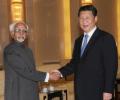
Vice President Hamid Ansari on Monday held talks with Chinese President Xi Jinping and conveyed the new Indian government's interest in furthering bilateral ties, even as he flagged off India's concerns over border related issues during his parleys with the top leadership in Beijing.

As its factories resumed operations after over two-month of grim battle against coronavirus, China is busy tapping into the vast business opportunities of export of key medical goods, specially ventilators and personal protection equipment (PPE), across the world, including India, where both private and government bodies are placing orders for the import of these products.
Committing to maintain peace and tranquility on the boundary, India and China on Saturday agreed that it was an "important guarantor for growth in ties and in this context pledged to early conclusion of negotiations on a proposed pact aimed at avoiding flare-ups on the border.

Chinese Foreign Minister Qin Gang will travel to India to attend the meeting of G20 foreign ministers on March 2, during which he is expected to hold his first bilateral meeting with External Affairs Minister S Jaishankar.

Pakistan's powerful Army Chief Gen Raheel Sharif's visit to Beijing comes in the backdrop of assertions by Pakistan that it will raise its concerns at the international level over India's successful test of supersonic interceptor missile.

Against the backdrop of recent Chinese incursion in Ladakh External Affairs Minister Salman Khurshid Saturday said the two countries are working on a new Border Defence Cooperation Agreement.

Prime Minister Manmohan Singh has said that commitment by Indian and Chinese leaderships to maintain peace and tranquillity at borders pending boundary settlement is an important guarantor for further progress in Sino-Indian ties, particularly growth of 2.5 billion people.

External Affairs Minister S Jaishankar on Wednesday held wide-ranging talks with his Russian counterpart Sergey Lavrov focusing on the Ukraine conflict, bilateral ties and issues relating to the G20 foreign ministers' meeting.
The naval exercises are being held under the landmark bilateral memorandum of understanding inked in May 2006 to step up military exchanges and cooperation in tune with the growing political, economic and commercial ties between them.

For someone like me who studied Sam so intently, if a lump could form in the throat during the emotive scenes, I think the cast did a superb job, notes Lieutenant General Syed Ata Hasnain (retd).
India and China signed on Tuesday 13 agreements, including one for encouraging two-way investment flows and another for streamlining iron ore exports, as part of efforts to take bilateral ties to a higher orbit.

India and China on Monday decided to deepen bilateral defence ties and maintain peace and tranquillity at the Line of Actual Control besides strengthening cooperation against terror, including at the international level.
India and China plan to resume the next round of talks to resolve differences over demarcation of borders and conduct joint military exercises so as to boost bilateral ties, National Security Adviser Shivshankar Menon said on Tuesday.

'If, as appears to be the case, India is on way to 'mending fences' with China, and China is equally desirous to 'reset' the relationship, this could be a self-reflexive moment in India's positioning vis-a-vis not just the Dalai Lama, but also the Tibetan issue and China as a whole,' points out China expert Alka Acharya.

Showing respect to the Indian flag, Prime Minister Narendra Modi on Wednesday immediately picked up the tricolour placed on stage at a BRICS meeting here to mark the standing place of every leader so as not to step on it.
Observers say China should re-address its policies towards India or else it will continue to face flare-ups increasing the tensions between the two countries at a time China's increasing tension with the US over Taiwan and the South China Sea besides the downturn in the Chinese economy which is hit hard by the zero-covid policy.
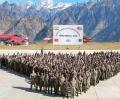
India on Thursday dismissed China's objection to the joint Indo-US military exercise near the Line of Actual Control in Uttarakhand's Auli, saying it did not give a veto to third countries on these issues.

Notwithstanding the strain in ties, the navies of India and China carried out a well coordinated operation to rescue a merchant ship in the Gulf of Aden which was hijacked by Somali pirates on Saturday night.

Against the backdrop of the standoff between Indian and Chinese troops in eastern Ladakh, the White House press secy said the United States was closely monitoring the current situation and supports its peaceful resolution.
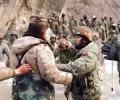
Some may see China's decision to antagonise India as strategically unwise. But China believes its prestige demands standing up to India, whatever the cost.
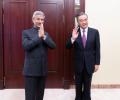
External affairs minister S Jaishankar has told his Chinese counterpart Wang Yi that the two sides should work for an early resolution of the remaining issues along the LAC in eastern Ladakh to restore peace and tranquility in the border areas as this has been an essential basis for progress in Sino-India ties.
